

ABB vs FANUC Robot Comparison: Which Industrial Robot Is Better?
There are often factory owners or automation engineers who come to us with a question: I want to go into robotics, but ABB and FANUC don't know which to choose, can you help me recommend a recommendation? To be honest, we have heard this question hundreds of times over the years. After working in this industry for a long time, you will find that as long as you talk about industrial robotics, you basically can't avoid these two brands.
Interestingly, if you ask ten engineers, they might give you eight answers. Some say that ABB's software is too awesome, while others say that FANUC is as tough as an old bull. Actually, if you stay in the factory long enough, you will slowly discover one thing: these two companies are really not better than each other, but they are better in different directions.
The following words are not any official propaganda, but some real feelings we have accumulated from our daily contact with equipment, visiting customer sites, and repairing robots.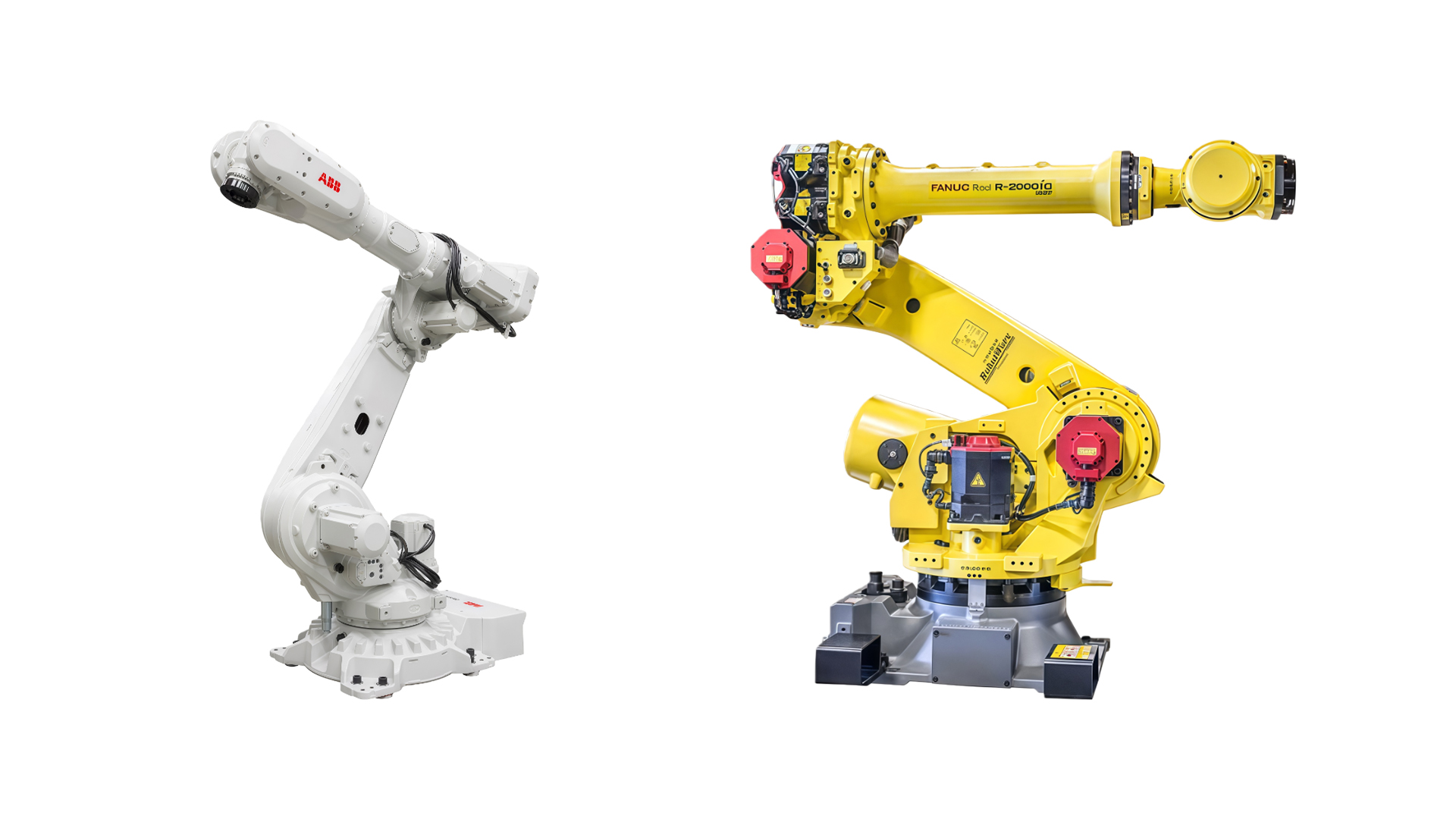
Let's first talk about the first impression ABB gives people
ABB is a European automation giant, headquartered in Switzerland and Sweden. Many people first come into contact with ABB, actually not with robots, but with frequency transformers, electrical equipment, or industrial automation systems. ABB also became a robot early, basically from automotive factories to electronics factories, everywhere there is one. Many engineers who first come into contact with ABB robots will notice its software systems. ABB particularly values digitalization and simulation, which is particularly evident in its RobotStudio software.
In the projects we have dealt with, if the automation units are relatively complex, such as multiple robot synergies, complex assembly lines, flexible production lines, and require large amounts of simulation verification in advance, many system integrators will tend to choose ABB. Why? Because the RobotStudio software can first assemble the entire robot workstation in the computer. Paths, beats, and whether they will collide, all can be simulated in advance. Some projects even have the robots tuned before they enter the factory. From an engineering perspective, this can indeed save a lot of debugging time.
Also, some of ABB's small robots are indeed quite accurate. For example, the more classic IRB 1200 in the IRB series can achieve repeat positioning accuracy of 0.011 millimeters. It performs quite well in electronic assembly, small parts grabbing, and other tasks.
Let's talk about the FANUC robot again
If ABB was the “software faction”, then FANUC felt more like an “industrial veteran”. Many people who entered the workshop and saw a row of yellow robots basically knew that it was FANUC. FANUC's greatest advantage was not that it was particularly strong in some technical point, but three words: stable, durable, and large in quantity.
In 2023, FANUC announced the sale of the 1 millionth industrial robot, a number that is very exaggerated in the industry. What does this mean? It means that countless factories around the world are running FANUC. Why do so many people use it? Because many factories like its “simple and reliable” quality. The programming method of FANUC is relatively straightforward, and many operators can write a basic program with a pointer. Without needing too complex a software environment, they can also run the robot. For mass-production factories, this method is actually more practical.
Especially in these scenarios, FANUC is particularly common:
- Car welding
- CNC machinery up and down
- Heavy loading and transport
- Stacks
- Metal processing
Another point is also very realistic. FANUC itself simultaneously makes digital control systems, servos, electric motors, and robots. Therefore, in many machine processing workshops, FANUC robots and FANUC machines are particularly often used in combination. Robots deliver materials directly to machines, and communication and system compatibility are quite mature.
What exactly is the position of these two in the market?
Looking at the global industrial robotics market, “the four big families” are usually mentioned: FANUC, ABB, Yasukawa Electric Motor, and Kuka. These four companies basically dominate the industrial robotics market. Many industry analysis reports mention that FANUC's global market share has long been at the top, around 20 percent, and ABB is also basically in the top few. In other words, these two are both industry leaders.
Programming, the difference is really not small
If you've really used these two types of robots, you’ll soon discover one obvious difference: the way they’re programmed.
1. ABB's RAPID language
The ABB robot uses a programming language called RAPID. Many software engineers find RAPID to be friendly, because it has a structure somewhat similar to traditional programming languages. In your program, you can write conditional judgments, loops, and modular logic.
For complex automation systems, this structure is much clearer. With RobotStudio, many programs can be developed offline on computers.
2. FANUC's TP programming
The most common method used by FANUC is TP programming, which means holding a demonstrator and teaching the robot actions step by step.
This method is particularly popular in the factory, why is that?
- Low learning threshold
- Speed up the path
- Operators are easy to get started
If you want more advanced development, FANUC also has the KAREL language, which can do more complex system functions. However, many factories rarely use it that deeply.
Load Capacity This Block
In terms of load range, both companies covered everything. From small robots weighing a few kilograms to large robots weighing hundreds of kilograms, there was everything. However, FANUC's product line was especially comprehensive in terms of heavy-duty load robots.
Some FANUC's carrying robots can carry loads exceeding 2,000 kilograms. These guys are commonly found in:
- Automotive production lines
- Moving large parts
- Heavy stacks
ABB also has overloaded robots, but in the overloaded field, the FANUC model selection is more extensive.
Precision is actually about the same thing
Many people like to ask, “Which robot is more accurate?” In fact, the accuracy of current industrial robots is very high. Most models have a repeat positioning accuracy of between positive and negative 0.02 and positive and negative 0.05 millimeters, which is enough for welding something, installing a part, and moving goods. More differences actually come from the factory design and process route, not the robot brand itself.
Reliability and Maintenance
One of the reasons many factories like FANUC is the durability of the equipment. Some automotive factories have many FANUC robots that have run continuously for more than ten years. The hardware structure is simple and highly stable, which is the strength of FANUC. ABB, on the other hand, is strong in software and system integration capabilities. In many projects, it particularly emphasizes digital factories, simulation systems, and intelligent manufacturing. Different factories will choose according to their own needs.
The actual application scenarios are also slightly different. Within the projects we interact with, they are generally distributed like this.
ABB is common in: electronic manufacturing, precision assembly, packaging production lines, spray painting systems, and collaborative robotics applications. For example, ABB's collaborative robots YuMi and GoFa are quite common on assembly lines.
FANUCs are common in: automobile welding, machine-tooling, stacking, heavy lifting, metal processing. Many machine-processing factories have entire rows full of FANUCs.
Which one to choose?
If your automation project is more complex, for example:
- Multi-robot collaboration
- A large amount of simulation is needed
- High system integration
Many engineers will lean toward ABB.
If your factory environment is more traditional, for example:
- Materials on and off the machine
- Moving heavy materials
- Long-term continuous production
FANUC is often a very safe choice.
Actually, the most realistic thing is that many large factories have both types of robots. Different jobs, different horses to choose.

