

Industrial Robot Spare Parts: What to Stock, What to Order on Demand
Every plant has that one shelf: parts that were bought for a good reason and never fit. The plant calls them spares, the trader dead stock, the integrator project leftovers, the repair shop the donor pile.
The shelf does not fill up because nobody cares. It fills up because of the sorting key. Most lists are sorted by price and by failure rate, and neither of those tells you whether a part will be recognised when it arrives.
Which robot spare parts should you keep on hand?
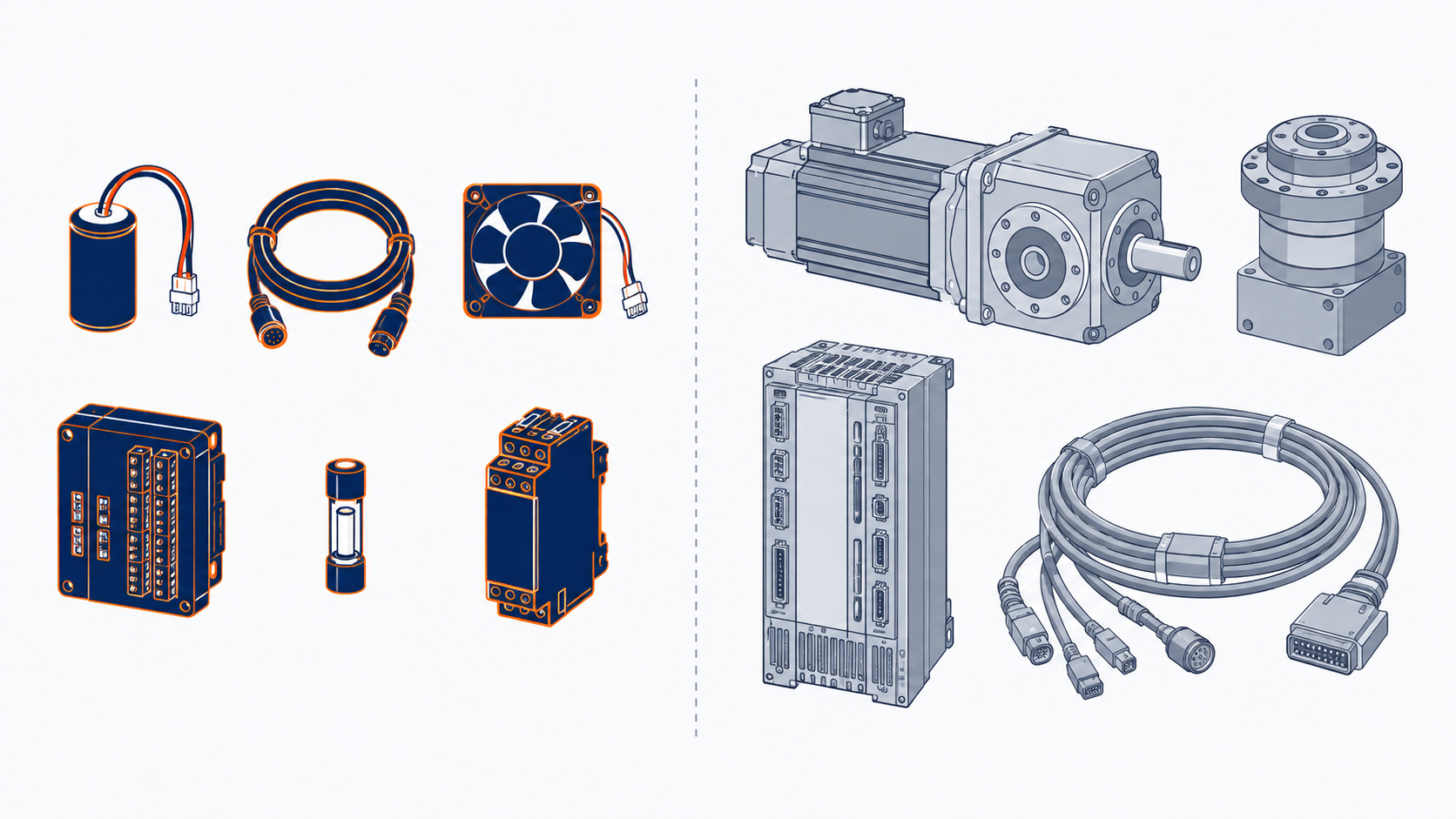
Keep on hand the parts that fail often and take weeks to arrive: backup batteries, cables and cable sets, fuses, cooling fans, I/O cards, encoder feedback cables, safety relays, and end effector wear parts. Order when they fail the high-cost, model specific assemblies: servo motors, reducers and gearboxes, controller boards, and complete harnesses. Buy a second unit of anything whose failure stops a cell you cannot stop.
Three things decide which side a part falls on. How long you wait for it. Whether it will fit and be recognised when it arrives. And who you are, because a plant, a trader, an integrator and a repair shop are protecting four different things. Price is not one of them, which is why an expensive part can be cheaper to keep than a cheap one is to fit.
Send us your list with the robot models. We will check it line by line against the controller generation and tell you which entries will fit, which ones you have been keeping for nothing, and which are worth a second unit. The model alone is enough to start.
How long a failure really costs you
The first of those three is time, and it is not the price of the part or how often it fails. It is how long the cell stays down.
It is not one number. It is a chain:
detection + diagnosis + approval + supply + replacement + restoration + validation
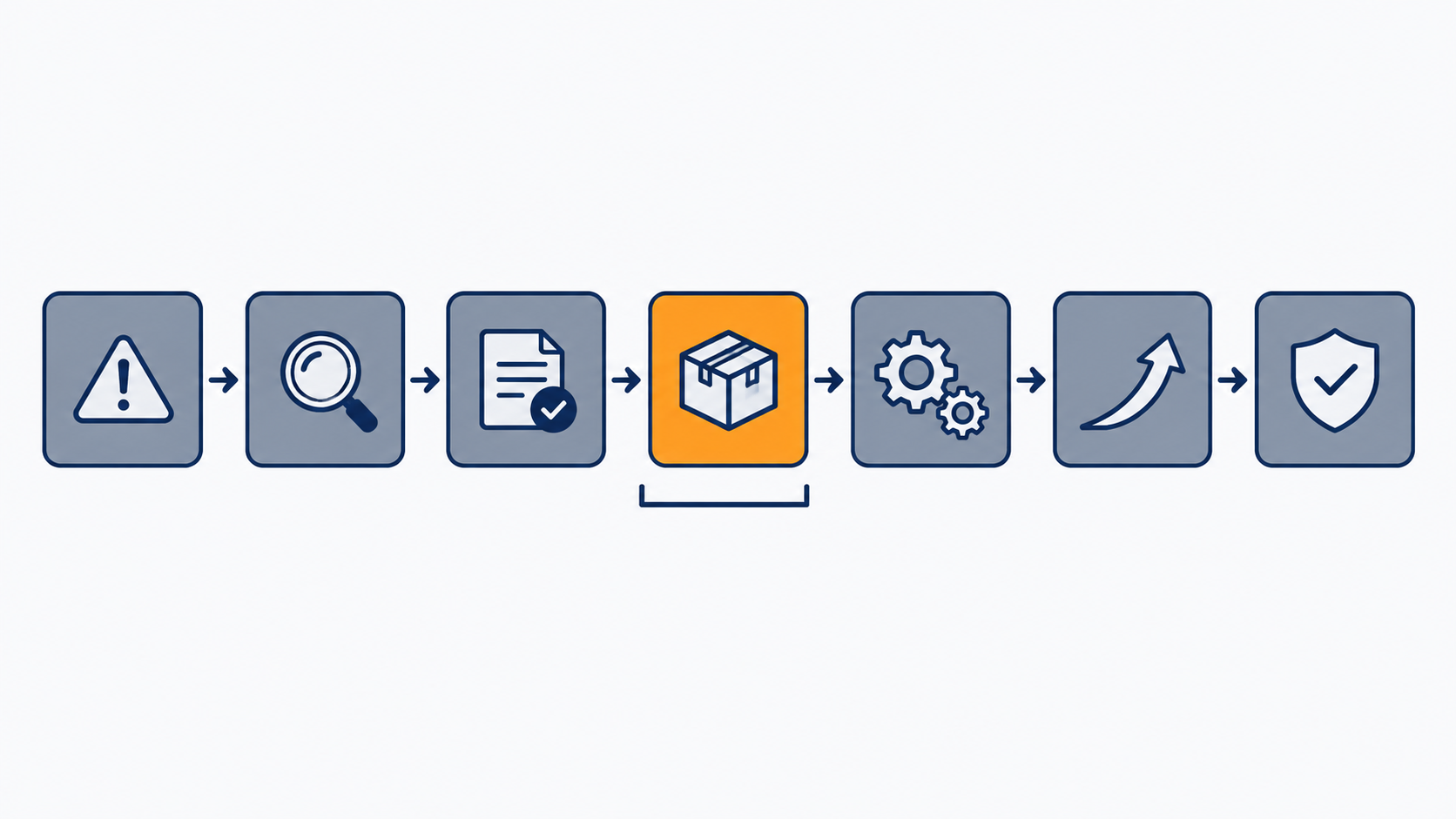
A spare part only removes one link, supply. But supply also decides how heavy the last two links are. A drive that arrives in three days still costs you a shift if nobody backed up the programs and parameters before the old one failed.
Two habits follow from this.
Treat the chain as a planning tool, not a reliability prediction. If you do not know how long a part takes to arrive, write “unknown” and leave it open. Putting zero there is how a spares list ends up too small, and a list that is too small only looks adequate until the first real failure.
The second habit is noticing that waiting is never neutral. A reducer that is already noisy keeps running, and the damage moves from the bearing into the gear set. A battery that is already low leaves you one power interruption away from a counter update. Some parts get more expensive the longer you leave them, and those are the ones that belong on a shelf.
Before you sort anything, get the identity right
“ABB robot” is not an identity. Neither is “FANUC R-2000”. One model name can cover several controller generations, arm revisions and payload variants that share almost no electronics.
Record the identity, not just the model
| Field | Why it matters | Where to find it |
|---|---|---|
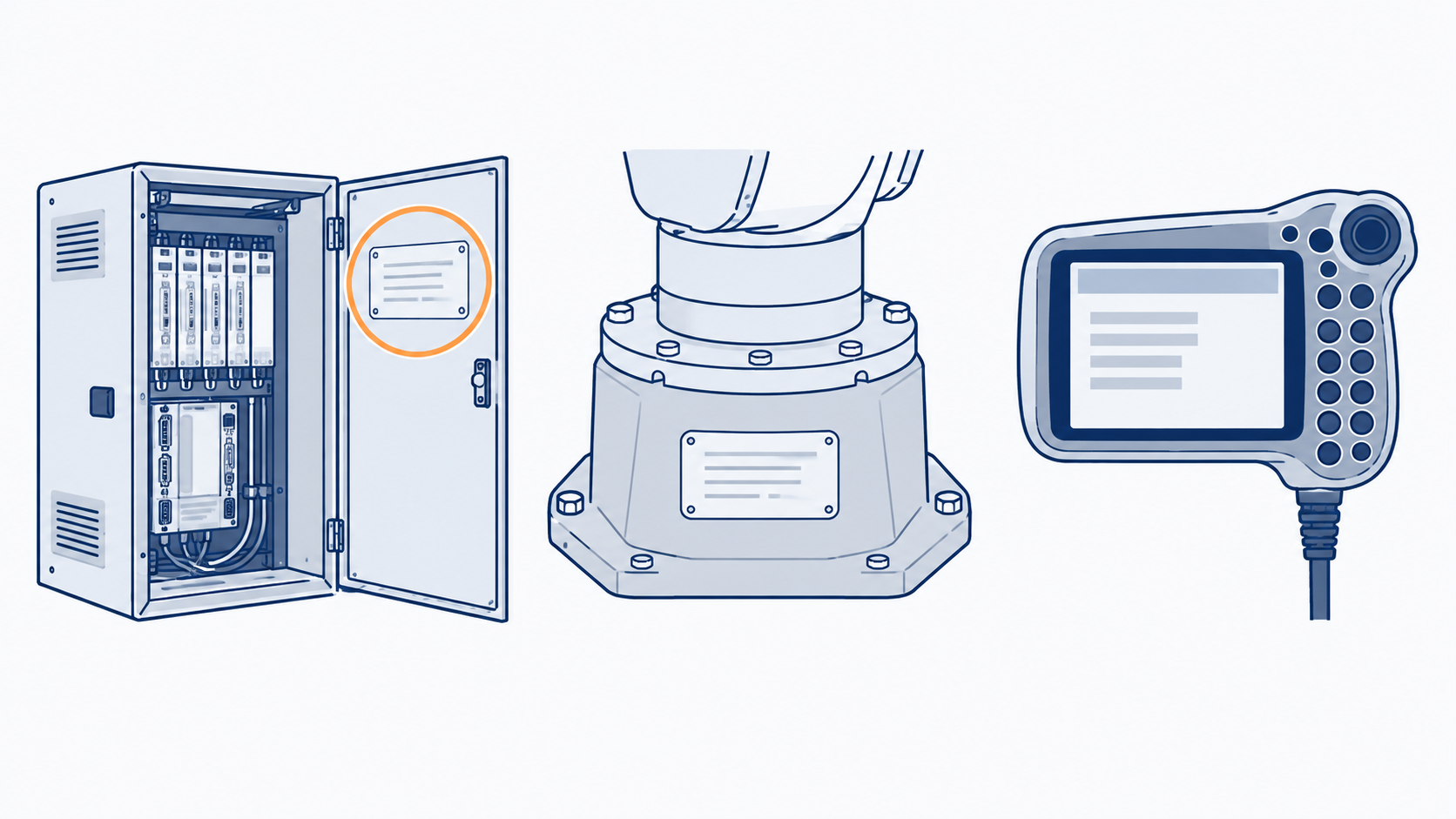
| Robot model and arm variant | The same model name can ship with different arm revisions | Nameplate on the arm |
| Controller model | Decides which electronics family you are buying for | Cabinet label or controller menu |
| Controller generation | Boards and drives are rarely interchangeable across generations | Controller nameplate and software screen |
| Software version | Some boards are only recognised at a specific software level | System information screen |
| Serial number | Narrows the build date and the parts list that applies | Arm and cabinet nameplates |
| Station or cell ID | Tells you which spare serves which cell when you run several | Your own layout drawing |
| Drawing or BOM revision | Catches the cell that was modified after delivery | Project documentation |
| Hardware revision and full suffix | The last characters often change voltage or connector type | Label on the failed component |
| Nameplate and connector photos | The fastest way to confirm a match when labels are worn | Your phone |
Two things about part numbers are worth slowing down for.
The full number, including suffixes and revision codes, is the only number that identifies a part. A one character difference can mean a different connector, a different voltage rating, a different gear ratio or a different mounting pattern.
A part that looks identical still has to clear five things before it behaves like the one it replaced: electrical characteristics, firmware, safety configuration, calibration data, and licences.
Three terms that decide whether a part fits
A controller generation is the controller platform a machine ships on. ABB ships IRC5 and OmniCore, FANUC ships R-30iB and R-50iA, KUKA ships KRC4 and KRC5, YASKAWA ships YRC1000 and YRC1000micro. Boards and drives from one generation rarely work in another.
A revolution counter records how many turns each axis has made since it was last set. The controller combines that count with the resolver reading to know the absolute position of the arm. The backup battery holds it while the controller is off, and it has to be set again if that data is lost. Some brands call that procedure mastering.
The dress pack is the cable set that runs along the arm to the wrist. It moves on every cycle and it wears out before almost anything else on the robot.
Make sure the failed part is the part you are ordering
The other expensive mistake is buying the right part for the wrong diagnosis. Both mistakes keep the line down. The difference is that a stockout is a wait, while a wrong revision is a wait followed by another wait.
Symptoms are less specific than they sound.
A noisy axis is not automatically a failed motor. It can be a reducer, a bearing, a brake, a cable, or simply lubrication. A servo alarm can come from the amplifier, the encoder feedback path, the power supply, a loose connection, or the motor itself. And a fair share of what gets reported as a robot fault is end-of-arm tooling: grippers, pneumatic valves, sensors, solenoids, vacuum generators and tool changers sitting inside the same fault envelope as the arm.
You do not need a full diagnostic report before you order. You need one habit: match the symptom to a shortlist of parts, not to a single part number.
Complete assembly or subcomponent
This one catches traders and repair shops more often than plants, because they buy from a description rather than from a machine.
A motor may be sold with or without its encoder, brake, pinion, connector and cable. A reducer may arrive bare, without seals, fasteners or mounting hardware. A pendant may be a complete unit or a shell with a display. Read the listing against the assembly you removed, and count what is actually in the box.
First, answer this: who are you?
The rest of this page gives four answers, because the same part is a different decision depending on what you do with it.
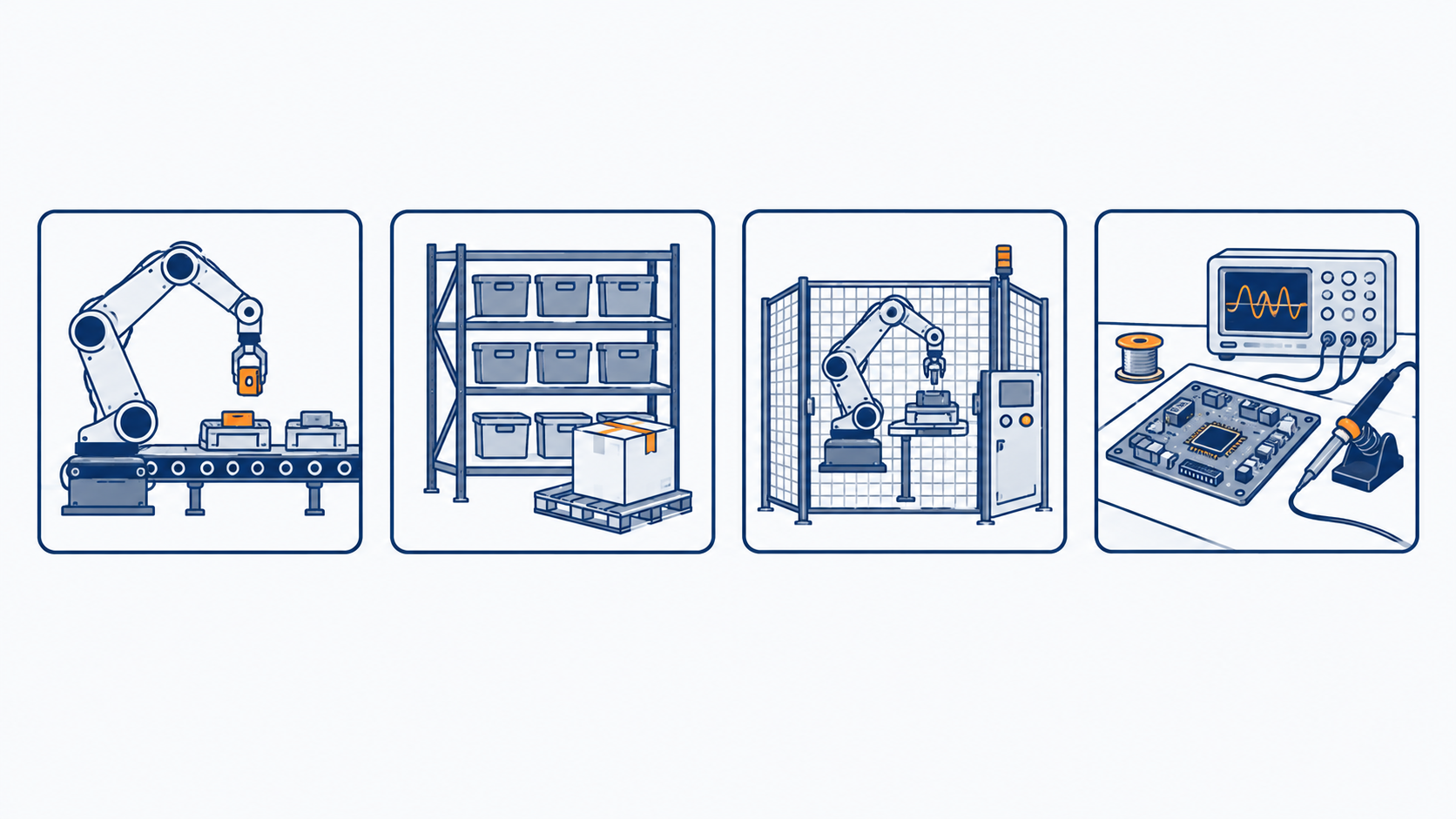
| Role | What you are protecting | What decides the answer | The line you draw |
|---|---|---|---|
| Plant | Uptime | Lead time against the cost of a stop | Stock what you cannot afford to wait for |
| Trader | Working capital | Turnover and how widely the part fits | Stock what sells, not what impresses |
| Integrator | Project delivery and acceptance | Installed fleet, acceptance list, the terms you signed | Stock what the customer will ask for |
| Repair shop | Repair throughput | Failure rate, repairability, donor availability | Stock what you can repair and test |
If you are two of these at once, which is common, use the stricter column. An integrator who also runs a demo cell should plan like a plant for that cell.
Sort spares by lead time, not by price
Price is the worst sorting key available for robot spare parts, because it has almost no relationship to what a failure costs.
Replace “is it expensive” with an addition:
total recovery cost = part price + freight + installation labour + programming + calibration + lost production + risk of a second failure
A cheap part that does not fit, or that needs a full re-mastering after fitting, can easily cost more than the expensive one that drops in.
Then sort by lead time in three bands rather than exact weeks: available quickly, available in weeks, available in months. Exact figures move too much to build a plan on, and published numbers differ by more than most buyers expect. What matters is which band a part sits in, and whether you can survive that wait without a workaround.
If you run the plant: stock against downtime
The test is simple: if this part fails, can the cell keep running while I wait? If the answer is no, it competes for shelf space.
| Item | Why it earns shelf space | How much |
|---|---|---|
| Backup batteries | Cheap, predictable life, and a flat battery costs far more than the part | Two per robot, on a replacement calendar |
| Fuses, fans, filters, contactors | Small failures that stop a controller | A small buffer, sized by controller count |
| Power supply modules | The controller will not boot without one | One per controller family |
| Teach pendant and pendant cable | The cable takes the abuse, the pendant takes the drops | One cable per cell, one pendant across identical units |
| Dress pack cable sets | The highest wear item on a moving arm | One set for your most critical cell |
| Encoder and feedback cables | Intermittent faults that are slow to diagnose | One per cable type in use |
| I/O cards and terminals | Common failure, quick swap | One of each type installed |
| Pneumatic fittings and solenoid valves | Fail often, cost little | A working buffer |
| End effector wear parts | Consumables by nature: cups, pads, tips, grippers | Consumable levels |
| Grease and shaft seals | Scheduled maintenance items | One service interval |
| Safety relays and e-stop components | A failed safety circuit stops everything | One of each type installed |
| Servo motor for the busiest axis | The exception that pays for itself | One, for the axis that works hardest |
Order when needed: servo motors in general, reducers and gearboxes, controller boards, complete harnesses.
Batteries are the clearest case for keeping two on hand. A low battery warning does not stop the robot, and it does not mean the data is already gone. It means you have a window. Replace the battery with the controller powered and the revolution counters survive. Let it go flat, then lose power, and you are updating counters axis by axis and re-checking the positions your programs depend on. The part is cheap. The recovery is not.
Most plants do not stock a reducer, and that is usually the right call. They are expensive and model specific, and a shelf unit can sit for years. But “we do not stock it” is not a plan. The plan is to know, before the failure, which route is actually open: repair of the existing unit, a certified refurbished unit, a donor from a decommissioned machine, or a borrowed unit from a partner.
A reducer also gives you warning, if you are listening. Noise, backlash, oil condition, motor current and temperature all move before the axis seizes. That window is where a planned replacement costs a fraction of an unplanned one.
If you trade parts: stock against turnover
Your constraint is capital that stops moving, not downtime. A part that fits forty machines is a different asset from a part that fits one.
Stock what crosses models and generations: batteries and battery holders, common cables, general purpose I/O modules, pendants for the models that move. Do not stock what is model specific and generation specific. A board for a controller that is already rare is not inventory, it is a bet.
Two more items belong in your buying checklist.
Ask what condition category you are actually buying. New original, used from a decommissioned machine, surplus stock, and repaired units are four different products with four different risk profiles, and the choice should follow the risk you can carry and the time you have.
Then ask the question that separates a careful supplier from a fast one: is the photo the actual unit, or a representative image? For a trader reselling to an end user, that difference is the whole deal.
If you integrate cells: kit against the project
Your spare parts decision gets made twice: once in the quote, and once at handover.
In the quote, decide what travels with the cell. Wear parts usually go in as a line item, because the customer will ask for them in year one whether or not you offer them. Commissioning consumables such as cables, fuses and I/O terminals are cheap to include and expensive to source at short notice.
At handover, write down who owns what. Parts that stay on site, parts you keep as the integrator, and parts the customer is expected to buy are three different lists. If the acceptance document does not say which is which, you will find out during the first breakdown.
Two traps are common. Customer sites often run several generations of the same brand, so a kit built for the new cell may not help the machine beside it. And parts you leave behind tend to become the customer's property by default, including the ones you meant to keep.
If you repair: stock against repairability
Forget how long a new part takes. What matters is whether you can put a working unit on the bench faster than a new one arrives.
Stock the parts that decide whether a repair is possible at all: high failure boards and modules, common power devices and connectors, displays and keyboard membranes, and the test fixtures and loads that let you prove a repair before it ships. A repaired board you cannot test is not a repair, it is a guess with a delivery date.
Do not stock what can only be replaced as a whole, and do not stock boards that are firmware or pairing sensitive if you have no way to test them.
Keep the failed unit whenever the customer will let you. It is your part number confirmation, your repair evaluation, and sometimes your donor.
Five traps that break every robot spare parts list
1. Controller generations are not interchangeable.
- ABB: S4, S4C, S4C+, IRC5, OmniCore. IRC5 and OmniCore are both in service.
- FANUC: RJ-3, R-J3iB, R-30iA, R-30iB, R-30iB Plus, R-50iA.
- KUKA: KRC1, KRC2, KRC4, KRC5.
- YASKAWA: XRC, NX100, DX100, DX200, YRC1000 and YRC1000micro.
Buying the right part for the wrong generation is the same as not having it. This is not a brand question. It is a platform question.
2. Mixed brands on one site. A hall with four brands is really six or eight platforms, because the generations differ too. Build the list by platform and generation, then label the shelf the same way.
3. Firmware, pairing and mastering. Fitting the part is only half the repair. Batteries need their data restored, encoders need mastering, safety functions need re-validation. That work is often more expensive than the part, and it is the reason a cheap substitute is rarely cheap.
4. Software and licences are not on the shelf. Programs, PLC and HMI projects, safety configuration, calibration data, network parameters and licence activation all have to be recoverable. Back them up while the system still lets you in. A replacement controller that powers up is not the same as a cell that can run.
Before you hand the cell back to automatic operation, the safety circuit has to be verified: e-stops, fencing, light curtains, enabling devices. Three things define a finished repair, and only one of them is electrical: the robot is safe to run, it still holds its path accuracy, and it does not come back with a second failure.
5. End of production. For machines past their controller's production life, the useful question is not “can I still buy it” but “until when”. Ask the manufacturer or your supplier for the last order date and the supported successor. And price the successor as a project, because a new controller can change interfaces, software and safety configuration.
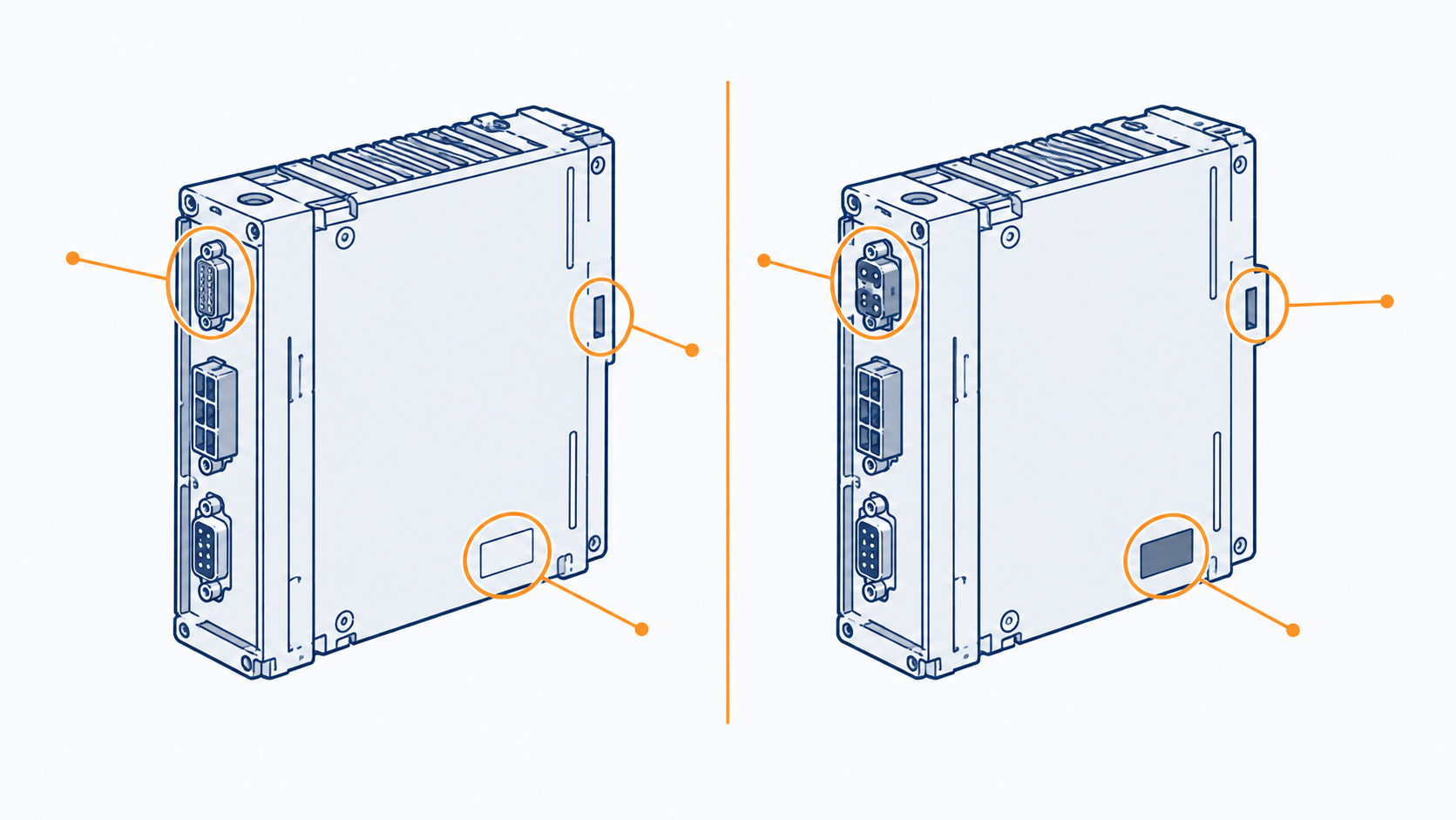
Three ways to get speed without stocking
Not every problem needs a shelf. Three routes get you a part faster than a purchase order, and all three need to be set up before you need them.
Borrowed or exchange units. Ask your supplier whether a loan or exchange unit exists for long lead items. Confirm the return conditions, the deposit, the freight and who handles the failed core before you accept one.
Certified refurbished and donor parts. A tested refurbished unit is often faster than a new build, especially for a controller generation that is winding down. Ask what was replaced, how it was tested, and whether the unit in the photo is the unit you will receive.
Repair and return. Sending the failed unit back for repair is often the most realistic route for discontinued hardware. Confirm who authorises the diagnosis, who pays freight, and how the repair is assessed, so that a repair quote does not arrive three weeks after you needed the answer.
For larger fleets, consignment is worth asking about: parts held at your site, paid for when you use them. It shifts the capital cost without shifting the risk of a wrong part.
One caution applies to all of them. A module sitting in your own store can still be the wrong version, reserved for another project, or missing its configuration. Physical presence is not availability. Give the ledger a status column, and use it.
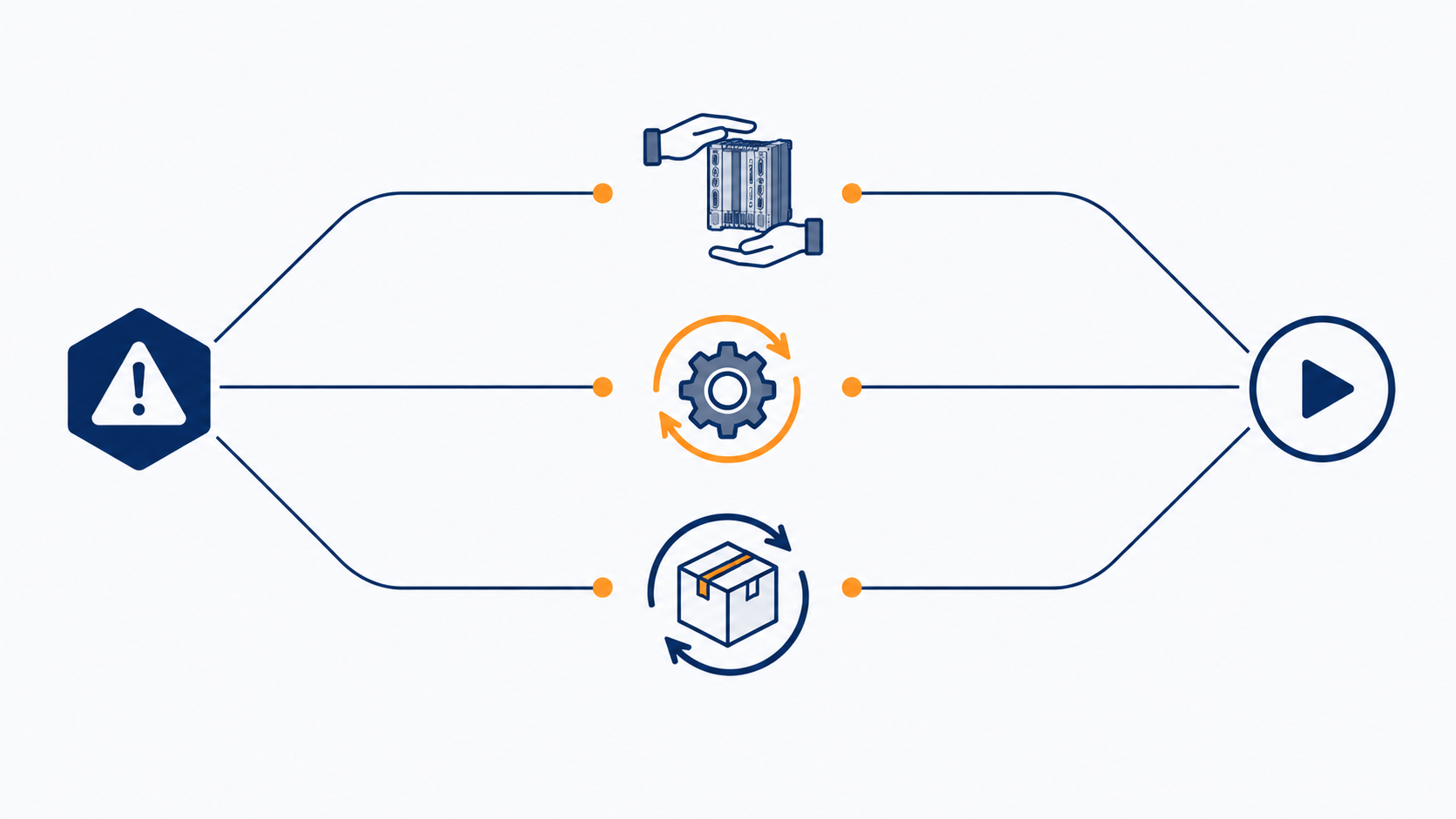
A one-page ledger plus a 30-minute audit
A spare parts ledger does not need software. It needs columns that answer four questions: what is it, will it fit, is it usable, and who is responsible.
Minimum fields: robot model, part name, part number, quantity, issue record, replenishment trigger. Then add the four that prevent most emergencies: controller generation, usable status, storage condition, review date.
Three ownership columns matter as much as the technical ones: who stocks it, who orders it, and who installs, returns and replenishes it. A list without an owner is out of date within a quarter.
Label to the axis, not just the model. Robot model, controller, axis number and revision on the box. In a plant with mixed generations, the real risk is a shelf with a part on it that nobody can confirm fits, not an empty one.
Which faults come back, and on which machines.
What you actually bought or replaced, not what you remember.
Per machine, from the controller, not from the project file.
Quick, weeks, or months. Leave unknown as unknown.
Downtime, turnover, acceptance list, or repairability.
The sequence that keeps a list alive is the same one that built it: record, classify, confirm, assign, review. Review is the step everyone skips, and it is the one that catches a controller going end of production, or a part quietly changing revision.
If you already have a spare parts list, send it over with the robot models. We will mark which entries are generation specific, which ones have a wider fit than you think, and which ones are worth keeping two of.
Frequently asked questions
How many backup batteries should we keep per robot?
Two per robot is the common practice: one installed, one spare that is still in date. Batteries are dated parts, so replace on a calendar rather than on failure, and keep the controller powered while you change one so the revolution counters are not lost.
Should we stock a spare reducer or gearbox?
Usually no. They are expensive, model specific, and a shelf unit can sit for years. Instead, decide in advance which route is open to you, repair, refurbished, donor or borrowed, and watch the axis for noise, backlash, oil condition, motor current and temperature. The exception is a single cell where a stop is unacceptable and a used unit is genuinely available.
We run several brands. Does that change the list?
Yes, but not by brand. Consumables cross brands: batteries, cables, fuses, fittings. Electronics do not, because they are tied to a controller generation. Sort by platform and generation, then by brand as a label only.
Does the list change if I trade parts, integrate cells, or repair boards?
It changes completely. A trader stocks what turns over and fits many machines. An integrator stocks what the acceptance list and the commissioning window demand. A repair shop stocks what it can repair and test, plus the fixtures that prove the repair. Same part, three different decisions.
Can we still get parts for a discontinued controller, and is a refurbished part acceptable as a spare?
Often yes, through specialist stock, donor machines and repair. Ask for the last order date and the supported successor rather than a general assurance. A refurbished unit is reasonable as a spare if it has been tested, if you know what was replaced, and if you keep the failed unit as a reference or a core.
Can I ask a technical question without buying anything?
Yes. Send the model, the serial number and what the machine is doing. If the evidence points to something other than the part you were about to order, we will say so.
What do I need to send to get a quote?
The robot model and serial number are enough to start. Controller model, the part number from the label, and a photo of the nameplate and connector make it faster. If the label is worn, photos of the failed part and the mounting area usually settle it.
Why does this page not give lead times?
Because published figures for the same part differ by weeks depending on the source and the channel, and a single number would mislead you. We confirm availability for the exact part and destination when you ask, and we would rather give you an accurate answer late than a wrong one early.
More than one of these usually applies at once. Tell us which machine is exposed and what you already hold, and we will tell you what is worth adding, what can wait, and what is not worth keeping at all.
If you have a fault in front of you, send the model, the serial number and the alarm text. If you are planning, send your current list and the controller model for each machine. If you are quoting a project, send the cell list and the acceptance requirements.
SongWei Robotics supplies and repairs industrial robot parts for ABB, FANUC, KUKA and YASKAWA systems. We are an independent parts and repair supplier and are not an authorised dealer for these manufacturers. Brand names and trademarks belong to their respective owners.
Sources
- ABB, product and lifecycle documentation for IRC5 and OmniCore controllers
- ABB, *Troubleshooting* manual 3HAC020738 (battery and revolution counter messages)
- ABB, *Operating manual, IRC5 with FlexPendant* 3HAC050941 (battery replacement procedure)
- FANUC America, parts, repair and product support
- KUKA, spare parts identification and ordering inputs
- YASKAWA, MOTOMAN controller documentation for DX200, YRC1000 and YRC1000micro
SongWei Robotics
Send the robot model and serial number, or a photo of the nameplate and the failed part. We confirm the match by controller generation before anything ships.

