
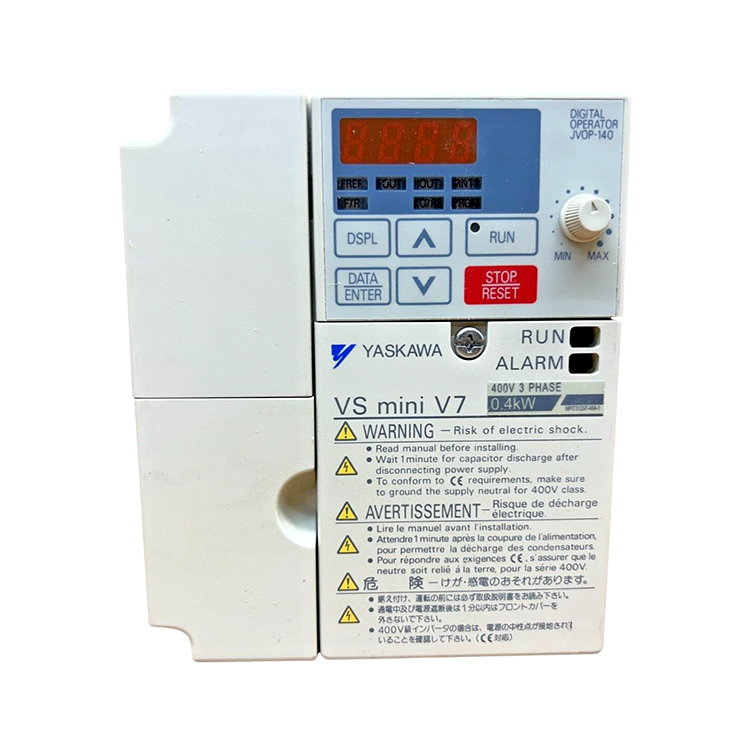
| Product Condition | New original or used original. Please confirm the condition with us before ordering. |
| Shipping | Ships from Shanghai, China. Delivery lead time: 3-5 working days. We ship via DHL, FedEx, or UPS with secure packaging. |
| Buyer Benefits | Genuine YASKAWA Varispeed V7 (VS-606V7) compact AC drive CIMR-V7AA40P4 for 400 V three-phase motor speed control up to 0.4 kW at 1.8 A rated output. Sine wave PWM output up to 400 Hz with V/f and voltage-vector control for fans, pumps, conveyors and small machines. 150% overload rating for 60 s. Send us the drive nameplate and your motor data so we can confirm the match before you order. |
| Item Location | Shanghai, China. |
| Payment | We accept PayPal, T/T (bank transfer), and Alibaba Trade Assurance. |
12,000+ parts in stock,Tested before shipping,Reply within 24 hours
Inquiry| Part Number | CIMR-V7AA40P4 |
| Brand | Yaskawa |
| Product Series | Varispeed V7 / VS-606V7 — Yaskawa's compact general-purpose inverter family. |
| Category | Compact general-purpose AC drive (inverter / VFD) for three-phase asynchronous motors. |
| Definition | Converts fixed-frequency three-phase mains into adjustable-frequency, adjustable-voltage output so a standard induction motor can run at variable speed instead of fixed speed. |
| Model Code Breakdown | Per the VS-606V7 nameplate decoding tables: CIMR-V7A + A (Japan domestic standards) + 4 (three-phase 400 V class) + 0P4 (0.4 kW max. applicable motor). The alternative design code is T (Asian standards). Confirm against your nameplate. |
| Input Voltage | 3-phase 380–460 V AC, 50/60 Hz. Allowable voltage fluctuation −15% to +10%; allowable frequency fluctuation ±5%. |
| Max. Applicable Motor Output | 0.4 kW |
| Inverter Capacity | 1.4 kVA |
| Rated Output Current | 1.8 A |
| Rated Input Current | 2.4 A |
| Max. Output Voltage | 380–460 V AC (proportional to input voltage) |
| Output Frequency Range | 0.1–400 Hz; max. output frequency 400 Hz (programmable) |
| Control Method | Sine wave PWM. The VS-606V7 400 V class specification table lists V/f control with voltage control selectable; Yaskawa describes the V7 as a voltage-vector-control inverter. |
| Frequency Accuracy | Digital reference ±0.01% (−10 to +50 °C); analog reference ±0.5% (25 ±10 °C) |
| Frequency Setting Resolution | Digital reference: 0.01 Hz (below 100 Hz) / 0.1 Hz (100 Hz and above). Analog reference: 1/1000 of max. output frequency. Output resolution 0.01 Hz. |
| Frequency Reference | 0 to 10 VDC (20 kΩ), 4 to 20 mA (250 Ω), 0 to 20 mA (250 Ω), pulse train input, or the frequency setting potentiometer on the digital operator. |
| Accel / Decel Time | 0.00 to 6000 s, acceleration and deceleration programmed independently |
| Overload Capacity | 150% of rated output current for one minute |
| Braking | Braking transistor built in. Continuous regenerative torque approx. 20%; approx. 150% with the optional braking resistor. Short-term average deceleration torque is listed by rating in the manual: 150% at 0.2 kW, 100% at 0.75 kW, 50% at 1.5 kW, 20% at 2.2 kW and above. |
| V/f Characteristics | Any V/f pattern can be programmed |
| Digital Operator | JVOP-140 (digital operator with potentiometer) — per the VS-606V7 parts identification section. |
| Protective Structure | Per the VS-606V7 manual, inverters with outputs 0P1 to 3P7 are rated IP20 (open chassis; IP00 with the top and bottom covers removed), and enclosed wall-mounted NEMA 1 is available as an option for those ratings. Confirm which construction your unit is. |
| Cooling Method | Information not stated in the 400 V class specification table — confirm on the unit nameplate. |
| Dimensions (H × W × D) | Information not publicly documented consistently for this model — confirm with your nameplate or the VS-606V7 manual. |
| Net Weight | Information not publicly documented consistently for this model — confirm with your nameplate. |
| Country of Origin | Information not officially documented — confirm against the nameplate. Note that the "A" design code refers to the standards the inverter was built to (Japan domestic standards), not to the country of manufacture. |
| Condition | New original or used original. Please confirm the condition with us before ordering. |
The V7 (VS-606V7) is Yaskawa's compact general-purpose inverter — the small-frame drive that fits where a full-size industrial VFD is more than the duty needs. It targets the bottom of the power range: this unit is rated for motors up to 0.4 kW at 1.8 A output on a three-phase 400 V supply, with a 1.4 kVA inverter capacity. That is the size class used for single small motors inside a machine or panel, not for a plant-level drive.
Two design choices define how it is used on the plant floor. First, the drive carries a digital operator with a frequency-setting potentiometer (JVOP-140), so speed can be set and monitored directly on the front of the unit without an external reference signal — which is why the V7 was widely specified for stand-alone machines and local operator control. Second, the braking transistor is built in, so adding the optional braking resistor raises regenerative torque to roughly 150% for axes that decelerate frequently; without it the continuous regenerative torque is about 20%.
In this catalog the V7 sits apart from the other Yaskawa drives by size and generation. The J1000 is the newer compact V/f-only micro-drive, the A1000 is the high-end vector platform, and the G5 is the established general-purpose vector family. The V7 is the compact predecessor: sine wave PWM with V/f and voltage-vector control over a 0.1–400 Hz range, 150% overload for one minute, and programmable accel/decel up to 6000 s. Because it is a 400 V class unit with a Japan-domestic-standards design code, the order code must match your supply voltage and the original specification before it is energized; it is not a drop-in for a 200 V V7 or a J1000 of similar rating.
If your drive shows a specific fault code, contact us with the exact code, the full order code on the nameplate and the motor data, so we can diagnose it and quote a matched replacement.
If you have any suggestions, please contact us
Contact Us
