

An unplanned stop burns money by the minute, and the first question on every maintenance engineer's screen is the same: what does this alarm actually mean? Reading the IRC5 event log correctly — instead of restarting and hoping — is often the difference between a ten-minute fix and a day of trial-and-error part swapping. This guide covers the alarm codes IRC5 maintenance teams meet most often, what each means, how to trace the root cause, and when the fault points to a part that needs replacing.
Note on wording: Alarm wording follows ABB Operating manual – Troubleshooting IRC5, document 3HAC020738-010 revision V (RobotWare 6.03). The English message wording in this guide is translated from the official Chinese edition, so your controller may display slightly different text. Always confirm against your controller's event log and system information.
1. How to Read an IRC5 Event Log
The event log is read on the FlexPendant (logger/event viewer) or through RobotStudio on a connected or virtual system. Every entry carries five pieces of information you should read as a set:
| Field | What it tells you |
|---|---|
| Event number | The code, e.g. 38103 — what tripped |
| Message | Short description of the condition |
| Consequences | What state the system entered (e.g. Motors Off, system failure) |
| Probable causes | The official list of likely origins, in priority order |
| Recommended actions | The official checks, in the order ABB intends them |
Two habits separate a quick diagnosis from a slow one. First, read concurrent events — the log timestamps several messages at the same moment, and the second or third line often names the real culprit. Second, treat the first error in a sequence, not the last, as your starting point: downstream alarms are frequently consequences, not causes.
Field note: when "no communication" is three different faults
A maintenance team called about an IRC5 controller that had lost communication and would not respond to the FlexPendant. The event log pointed at the main computer, and swapping the unit would have been the obvious first move. Before ordering anything, the board was pulled and inspected. Three separate faults turned up:
- Oxidised and partly dry-soldered pins on the Ethernet interface circuit, interrupting transmit and receive signalling.
- Aged low-voltage filter capacitors that had lost capacitance, leaving ripple on the board's digital supply above what the communication ICs tolerate.
- A worn spring contact on the communication terminal strip, with contact resistance high enough to degrade the link.
Not one of those three would announce itself in the event log. Together they produced a single symptom: no communication. Once the board-level faults were confirmed, the module was replaced with a serviceable main computer — for example the ABB 3HAC041443-003 DSQC639 computer unit — and the harness terminations were re-made. The cell was then run for two hours with repeated start/stop cycles to confirm the link held.
What this shows: the alarm tells you where the symptom surfaced, not what caused it. Before you order a board, check the physical layer — connectors, contacts, and supply quality. And note that component-level repair inside a controller module is specialist work: replacing the complete unit is both faster and safer than attempting board-level fixes in the field.
2. Positioning and Calibration Alarms
This family is the most common reason an IRC5 refuses to run after a power cycle — and most of it traces back to the serial measurement board (SMB) system and its battery.
| Code | Message | What it means | Official action |
|---|---|---|---|
| 20032 | Revolution counter not updated | One or more absolute measuring axes are not synchronised | Move the axes to the sync position and update the revolution counters |
| 50057 | Joint not synchronized | After power down, joint position is too far from the position before power down | Update the revolution counters again |
| 50053 | Too large revolution counter difference | The arm was moved manually while power was off; or SMB, resolver or cable fault | 1) Update the revolution counters 2) Check resolver and cables 3) Inspect the SMB and replace it if faulty |
| 50296 | Manipulator memory data difference | Data or serial-number mismatch; SMB or controller swapped, or configuration changed | Verify correct configuration data and serial number; transfer data as described below |
| 20034 | Manipulator memory not OK | SMB data differs from the controller — after SMB/controller replacement or manual memory clear | Update the manipulator memory per the IRC5 Operating manual |
| 10039 | Manipulator memory not OK (start-up) | Same mismatch, detected at start-up | Update the manipulator memory |
A healthy start-up, by contrast, shows 10038 – Manipulator memory OK: a useful contrast when you want to know whether the SMB data survived the night.The shared fix. Many of these entries end with the same instruction: update the revolution counters. On a robot that was simply powered down (or moved by hand during maintenance), that is the whole fix. When the alarm keeps returning, or appears together with 38103-style communication events, suspect the measurement chain itself — starting with the ABB 3HAC044075-001 SMB battery unit: a low battery erodes the SMB's stored data and shows up as exactly these calibration alarms. Battery life is not publicly documented — confirm against your controller's event log and system information.
Swapping SMB or controller hardware? For 50296 specifically, check on the FlexPendant that the correct configuration data and serial number are loaded in the controller. If you fit an SMB from another manipulator, first clear the SMB memory via the FlexPendant, then transfer data from the controller — not the other way round.
3. SMB and Measurement System Alarms
| Code | Message | Consequence (rev. V) | Official causes |
|---|---|---|---|
| 38103 | Communication lost with the SMB | System enters system failure state | Poor contact or damaged cable (shielding) — especially when non-ABB external axis cables are used; SMB board or axis computer fault |
The official recommended actions come as an ordered list, and the order is the diagnosis:
- Reset the revolution counters.
- Ensure the cabling between the SMB and the axis computer is correctly connected and meets ABB specification.
- Ensure the shield is bonded at both ends.
- Keep the cabling away from strong electromagnetic interference.
- Replace any faulty unit.
Work that list from the cheap end. Connectors and cable shields cost minutes; boards cost money and downtime. The non-ABB cable warning deserves emphasis: axis cables whose shield is not bonded to ABB specification are a classic reason 38103 keeps coming back. When the checks point at the measurement hardware itself, the units involved are the ABB 3HAC031851-001 DSQC 633A SMB unit, the ABB 3HAC12815-1 DSQC601 axis computer, or — where the robot uses one — the ABB 3HAC044168-001 RMU101 serial measurement board. Which board your robot carries is not publicly documented — confirm against your controller's event log and system information.
4. Motion and Collision Alarms
| Code | Message | Official meaning | Official actions |
|---|---|---|---|
| 50056 | Joint collision | Actual torque exceeds the commanded value at low or zero speed; may be a jam error (arm obstructed) or hardware error | Check whether the arm is jammed; check hardware; check other hardware event log entries |
| 50055 | Joint load too high | Incorrect load data, excessive acceleration, strong external process force, low temperature, or hardware fault | Check load data; reduce acceleration or speed; check hardware |
| 50052 | Joint speed error | System error or conflict | Check joint and hardware tuning parameters and external forces; reduce programmed speed |
The 50056 entry rewards a physical look before anything electrical — an arm resting against a fixture produces the same alarm as a failing drive component. Check the concurrent hardware events before you open the cabinet.
On 50055, note the low temperature cause — a cold hall on a Monday morning can legitimately trigger a joint load alarm on a robot that ran fine on Friday. Confirm against your controller's event log and system information before ordering anything.
5. Drive and Motor Alarms
34316 — Motor current error
Consequence: the system goes to Motors Off. The five official probable causes, in the official order:
- Motor data in the configuration file incorrect
- Motor cable poorly connected or damaged
- Short circuit between phases or to earth
- DC link voltage too low
- Mains supply voltage out of specification
The recommended actions mirror that order — verify the configuration data, then the motor cable, then check for shorts, then check the event log for a DC link error, then the incoming supply. Start with the event log: a concurrent DC link message (34402) reorders your priorities immediately.
39504 — Brake power supply overload
Consequence: no operation until corrected; system enters system stop state. Official causes: short circuit in the brake supply cable; external axis brakes drawing too much power; power unit cable not correctly connected to the drive module. The actions run from cable seating to total external-axis current draw and finish with a measurement: ensure the 24 V brake voltage is within the specified range (circuit diagrams: refer to the IRC5 Product Manual).
34402 — DC link voltage too low
Consequence: no operation is possible until the fault is corrected — the system goes to Motors Off. Official cause: mains supply voltage to the rectifier unit out of specification. Actions: check other supply-related event log messages; check the mains voltage and tolerance limit; verify the transformer jumper voltage selection if fitted; inspect all three-phase components inside the drive module (main switch, filter, fuses, contactor) and their wiring.
37001 — Motors ON contactor activation error
Consequence: no mechanical unit can be run, manually or automatically. Official causes: contactor run chain open; contactor mechanical or electrical fault; FlexPendant enabling device switched too fast, or incorrect system configuration. The first official action is deliberately low-tech: confirm the error, release the enabling device and press it again after about one second. If that clears it, you had a human-factor event, not a hardware failure. If it does not, check the safety system cabling, the concurrent log messages, and the system action configuration for the Motors ON contactor relay.
⚠️ Official safety warning (reproduced in substance from the manual): for 37001 and 20212 — do not continue to use the robot until the fault has been identified and eliminated. And for any work inside the drive module: disconnect power, lock out, and allow the DC link to discharge before touching anything; work must be carried out by qualified personnel.
When the checks land on the drive or power hardware, the replacement units are the ABB 3HAC029818-001 DSQC 663 drive unit or the ABB 3HAC13389-2 DSQC611 contactor unit, depending on which part of the chain the evidence points to.
6. Safety and System Alarms
| Code | Message | What happened | Official recovery |
|---|---|---|---|
| 10013 | Emergency stop state | An emergency stop device connected to the ES input opened — internal (cabinet or FlexPendant) or external (customer-connected) | Identify which device caused the stop, close/reset it, return to Motors ON from the control module |
| 10014 | System failure state | Too many faults — check concurrent event log messages via the FlexPendant or RobotStudio | Analyse the log, fix the underlying fault, restart per the Operating manual |
| 20212 | Dual channel fault, run chain | Only one of the two run chains closed — a switch on the run chain is faulty or not properly connected | Check cabling and connections; use concurrent messages to identify the switch; ensure all switches operate; hold and reset the emergency stop button to return the chain to a defined state; replace the faulty switch if nothing is loose |
| 20600 | Non-official RobotWare version | A test/validation build is in use | If this is a production system, install a formal RobotWare release as soon as possible |
10013 is a diagnosis, not a fault: something opened the stop circuit, and the log tells you which side — internal devices are marked on the circuit diagram, external ones are those you or the system builder wired in, and a failed external ABB CE4T-10R-02 emergency stop pushbutton is a common replacement. On the states these codes set: 10013 interrupts all running programs immediately and holds the robot axes on mechanical brakes; 20212 puts the system in SYS HALT; 10014 blocks program execution and manual jogging until the restart. For 20212, the same safety warning as section 5 applies: identify and eliminate the fault before returning the robot to service.
10014 deserves respect: "restart and see" is precisely what the official actions tell you not to do first — the log analysis is step one.
7. Maintenance Reminders (10106–10112) and the SIS Counters
The 101xx series is not a fault at all — it is the Service Information System counting:
| Code | Meaning |
|---|---|
| 10106 | Calendar days since last service reached — service now due |
| 10107 | Calendar days remaining until service |
| 10108 | Operating hours since last service reached — service now due |
| 10109 | Operating hours remaining |
| 10110 | Gearbox service required |
| 10111 | Gearbox service overdue |
| 10112 | System date/time changed — disrupts SIS calendar notifications |
Three counters run in parallel: calendar time, operating time, and gearbox condition. The action for every one of them is the same: carry out the service and reset the relevant SIS counter; for 10112, review the SIS calendar limit and warning parameters.
What the intervals are: not publicly documented — confirm against your controller's event log and system information. Every interval is system-configurable, and the manual deliberately prints the counters as placeholders. Read the numbers off your own controller's SIS display, and treat dusty or temperature-hostile environments as a reason to shorten intervals rather than stretch them. Dust control starts with cabinet hygiene, including elements like the ABB 3HAC028815-001 dust filter on cabinets so equipped.
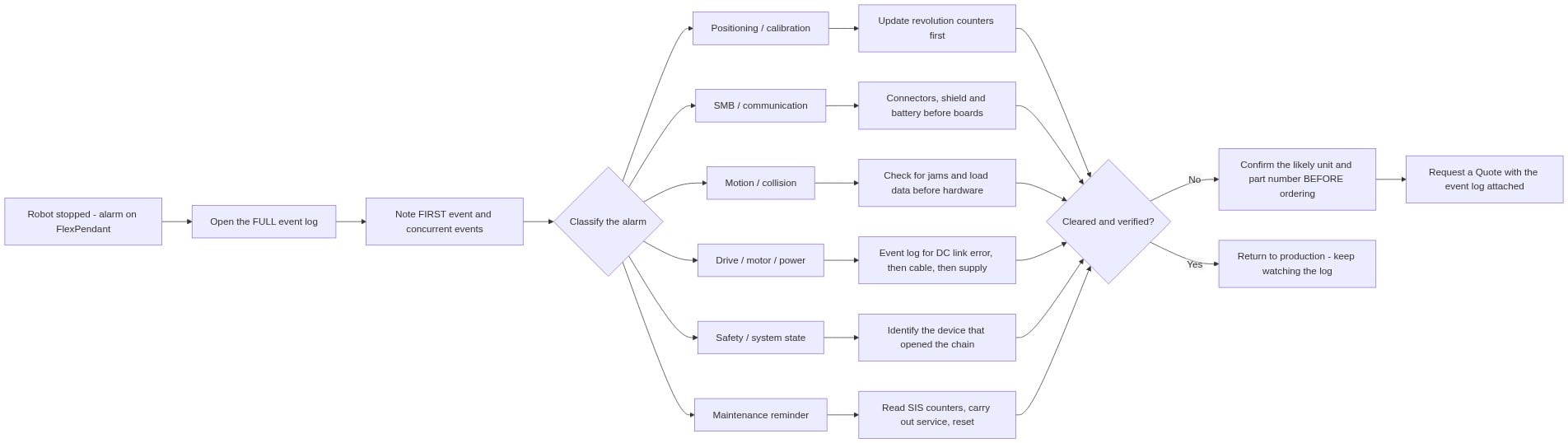
8. A Practical 5-Step Troubleshooting Workflow
- Read the FULL event log — not just the last line. Note the first event and every concurrent message.
- Classify the alarm: positioning / communication / motion / drive / safety / maintenance. The class dictates the checks.
- Check the cheapest cause first: battery → connector → cable → board. The official action lists in sections 2–6 are already ordered this way.
- Confirm before restarting. A restart that "fixes" a hardware fault has not fixed it; it has rescheduled it.
- Verify after the fix — run the cell through repeated start/stop cycles and watch the log before you call it done.
9. When an Alarm Means You Need a Replacement Part
Reset-and-go vs must-replace
| Pattern | Usually means | Your move |
|---|---|---|
| Alarm after power cycle, robot moved by hand | Lost synchronisation | Update revolution counters — no parts |
| 10013 / 10014 after operator intervention | Correct system response | Clear the device, restart — no parts |
| 38103 returns after cable/shield checks | Measurement chain hardware | SMB unit or axis computer — swap the cheapest item first |
| 34316 with confirmed phase-to-earth short in the motor cable | Damaged cable / motor | Cable first, then motor — order by robot model |
| 37001 survives the one-second enabling-device retry | Contactor or run-chain switch | Contactor unit / pushbutton — do not run until eliminated |
| 50053 returns repeatedly | SMB, resolver or cable | Replace the faulty item after the cable check |
Consolidated part list (units referenced in this guide)
- ABB 3HAC041443-003 DSQC639 computer unit — main computer; replaces the module when communication faults are confirmed at board level
- ABB 3HAC044075-001 SMB battery unit — protects SMB stored data; low battery surfaces as calibration alarms
- ABB 3HAC031851-001 DSQC 633A SMB unit — serial measurement board on the manipulator
- ABB 3HAC12815-1 DSQC601 axis computer — measurement-chain controller in the cabinet
- ABB 3HAC029818-001 DSQC 663 drive unit — axis drive module for motor-current and drive-system faults
- ABB 3HAC13389-2 DSQC611 contactor unit — Motors ON contactor hardware
- ABB CE4T-10R-02 emergency stop pushbutton — external stop-circuit device
Repair the encoder, or replace the motor?
An IRB 6640 working in a die-casting cell lost its axis 6 motor. The cause was not electrical: sustained high ambient temperature combined with dust ingress had degraded the encoder inside the motor. On paper, repairing the encoder is the cheaper option.
The team chose to fit a new original motor instead. The deciding factor was downtime, not parts cost — an encoder repair means pulling the motor, stripping it, sourcing the encoder, rebuilding and re-verifying, all while the cell sat idle. Swapping in a complete motor returned the robot to production in a single intervention.
How to make the same call: weigh the hours your line will be down against the price difference between repairing and replacing. And if the environment is what killed the first motor, treat the cause as well — sealing, air supply, ambient temperature — or you will be doing the same job again before long.
Not sure whether your fault needs a new SMB battery, an SMB board, or a drive module? Send us your robot model, controller type and the alarm code.
Before you order — TBC checklist
- [ ] Robot model and controller type confirmed (IRC5 vs IRC5C, RobotWare version)
- [ ] Full event log exported, including concurrent messages
- [ ] The unit part number read from the physical label of the installed unit, not from memory
- [ ] Whether your robot uses an SMB board or an RMU101 configuration — confirm against your controller's system information
- [ ] SIS intervals read from your own controller, not from any published figure
- [ ] Environmental causes (dust, temperature, cabling) addressed, or the replacement will meet the same fate
10. FAQ
What does ABB alarm 20032 mean? Alarm 20032 means one or more absolute measuring axes are not synchronised — the revolution counters need updating. Move the axes to the sync position and update the counters; the alarm itself does not indicate a broken part.
Can I keep running a robot with alarm 50057? No. 50057 (joint not synchronized) means the joint position after power down is too far from the position before power down, and automatic operation must not continue until the revolution counters are updated again. The fix is procedural, not a parts order.
How often should the ABB SMB battery be replaced? There is no fixed period — it depends on duty cycle and is not publicly documented; confirm against your controller's event log and system information. A weak battery announces itself as position and calibration alarms (20032, 50053, 50057) appearing around power cycles.
Why does alarm 38103 keep coming back? 38103 returns when the underlying cause is still present — most often a cabling problem: a shield not bonded at both ends, a damaged cable, or a non-ABB external axis cable that does not meet ABB specification. Work the official list in order (connectors → shield → interference → boards); if the cabling is sound, the SMB board or axis computer is the remaining suspect.
Does restarting fix every IRC5 fault? No. A restart clears nothing that has a physical cause — it only clears the state. The manual's own guidance for 10014 (system failure) is to analyse the event log and fix the underlying fault first. If an alarm disappears after a restart and returns, treat the return as the diagnosis.
How do I clear the 10106 maintenance reminder? 10106 clears when the service is carried out and the relevant SIS counter is reset — it is a service reminder, not an error to be dismissed. If the system date was changed (10112), also review the SIS calendar limit and warning parameters so calendar-based reminders fire correctly again.
Which spare parts should I keep on hand for an IRC5? Keep on hand the parts whose failure stops production and can be replaced quickly on site: an SMB battery unit, an emergency stop pushbutton, and — depending on how much downtime you can tolerate — a computer unit, an SMB board and a drive module. Which exact part numbers fit your machines is not publicly documented — confirm against your controller's event log and system information before ordering.
11. Still Stuck? Send Us Your Event Log
Still seeing an alarm you can't clear?
Send us your event log and controller details. Our team will help you identify the likely faulty unit and confirm the correct part number before you order.
Refer to ABB Operating manual – Troubleshooting IRC5, 3HAC020738-010, for the complete alarm list and the official wording for each code. This guide is an independent troubleshooting resource; ABB brand and product names are trademarks of their respective owner. Work inside the controller must be performed by qualified personnel with power disconnected and the DC link discharged.

